Warmup Pool Composition: Google and Microsoft vs IMAP
What is HotHawk?
HotHawk is cold email software used by teams like yours to send high volume cold email.
Special offer
Get 50% more sending, FREE.
50% extra sending on any plan, every month.
On this page
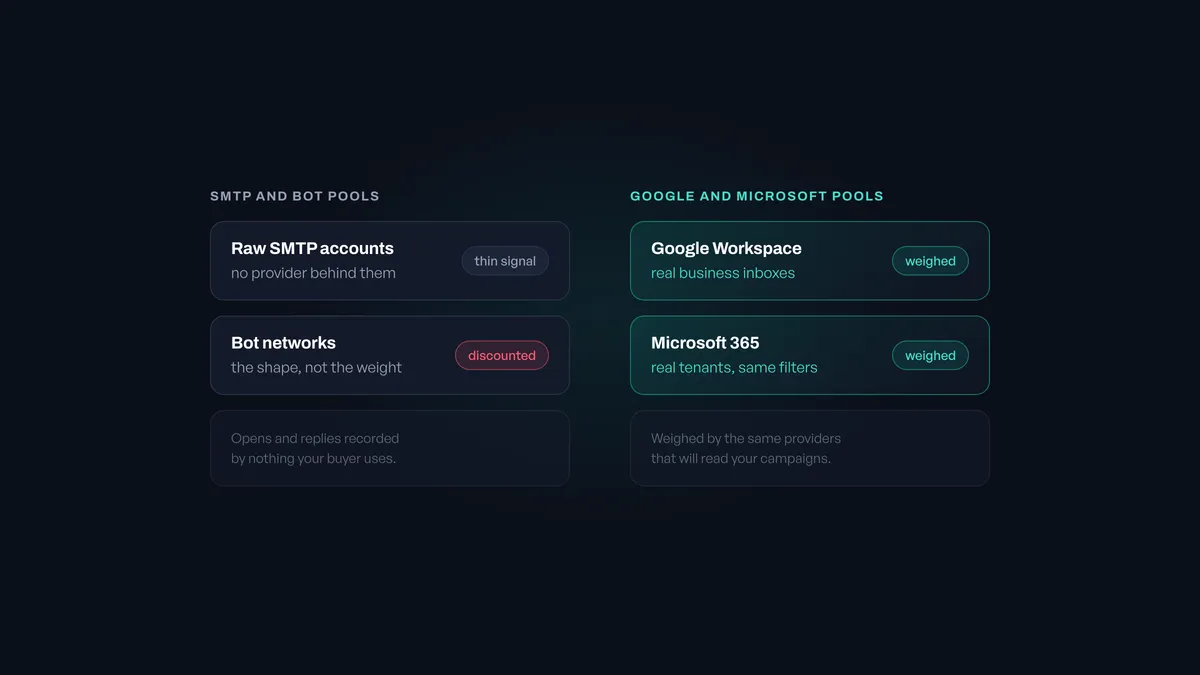
Most warmup comparisons argue about ramp curves, daily volumes and how human the AI-written content reads. Those matter less than the question almost nobody puts on the table: what is on the other end?
Warmup is engagement. Something receives your email, opens it, replies to it, and that behaviour is what a provider reads as evidence you are a real sender worth trusting. So the composition of the pool your mailboxes engage with is not a detail. It is the mechanism.
The short version
- Warmup works by generating engagement signals, so what generates them decides what they are worth.
- Engagement from real Google and Microsoft mailboxes is read by the same filters that will read your campaigns.
- Bot networks and raw SMTP accounts produce the shape of warmup without much of the credibility.
- This is a mechanism argument, not a published A/B test, and it is worth saying so.
- The vendors' own pricing is the strongest available evidence: Instantly sells a Google and Microsoft only pool as a premium add-on.
What a provider is actually looking at
When Google or Microsoft decides whether your mail belongs in the inbox, it is weighing signals about your domain and your mailbox: how much you send, how fast that changed, how often you bounce, how often people mark you as spam, and crucially whether anyone engages with what you send.
Warmup exists to put some positive history on that record before your real campaigns start. The engagement is manufactured, and everyone involved knows it is manufactured, which is exactly why its source matters. A provider is not counting events. It is weighing them.
- Engagement from a real Google or Microsoft mailbox happens inside the system doing the judging, from an account with its own history, its own reputation and its own normal behaviour. It is also engagement from the kind of mailbox your actual B2B prospects use, which means the signal is read by the same filters that will read your campaigns.
- Engagement from a bot network or a raw SMTP account happens somewhere the provider has little reason to weigh, from accounts with no meaningful history, that look nothing like your prospects. You get the shape of warmup without much of the credibility.
That is the whole argument. It is not complicated, and it is not a feature list.
The honest limits of this argument
Here is the part most vendors skip, including, until now, some of our own pages.
This is a mechanism argument, not a controlled experiment. Nobody has published an A/B test isolating pool composition with everything else held constant, and that includes us. Doing it properly would mean running identical domains, identical content and identical ramps against different pools for months, and then being confident the difference was the pool rather than the dozen other things that move inbox placement.
So treat anyone claiming a hard percentage uplift from pool composition with suspicion. What exists is the reasoning above, and something more interesting: what the vendors do with their own pricing.
What the vendors’ own pricing reveals
Nobody puts a premium on something they think is worthless. The clearest evidence available is how the market prices pool composition.
Instantly sells a Google and Microsoft only pool as a paid upgrade. Its own help documentation states that Premium Warmup Pool access “costs start at $500/month per workspace” and that the pool “Only contains Google and Microsoft accounts”. For private pools it goes further and states a requirement: “at least 50% Google/Outlook for effective results.” That is a vendor telling you, in its own words and with its own price tag, that provider mix changes how well warmup works. (Instantly’s premium pool documentation, read 18 October 2026.)
Smartlead publishes data on the connection method. Its own blog states that “OAuth connections have a 99.7% uptime rate compared to 97.2% for SMTP/IMAP connections, which occasionally break when app passwords expire.” That is about reliability rather than reputation, but it points the same way: the OAuth path to Google and Microsoft behaves better than the SMTP path. (Smartlead’s post, read 18 October 2026.)
lemwarm connects other providers over SMTP and IMAP. Its own documentation puts it plainly: “Google and Microsoft connect with one click. For other providers, you’ll add SMTP and IMAP details.” Worth noting it does not enumerate which providers, so we will not either. (lemwarm’s guide, read 18 October 2026.)
Read those together and a pattern shows up. The market treats a Google and Microsoft pool as the better product, and prices it accordingly. That is not proof, but it is a lot more honest than a made-up statistic.
Where HotHawk stands, including the part people dislike
Our position is simple and it has a cost attached.
HotHawk warmup only covers Google Workspace and Microsoft 365 mailboxes connected over OAuth. That is the only pool we run. There is no premium tier to upgrade into and no broader pool to opt into, and unlimited warmup is included on every plan from $97 a month rather than sold as a $500 add-on.
The cost of that choice: if your mailbox is on cPanel, webmail or a small host, connected over IMAP and SMTP, it cannot warm up with us. It can send campaigns from HotHawk perfectly well, and rotation covers it like any other mailbox. It just cannot join the warmup pool.
People do not love hearing that, and it loses us some customers who want one tool for everything. We keep the restriction anyway, for a reason that is about the pool rather than about you: every arbitrary IMAP account allowed in is engagement of unknown value being generated for everyone else already in it. A pool that accepts anything is a pool worth less to every member.
So if you need warmup for mailboxes outside Google and Microsoft, a tool with a mixed network genuinely is the better fit, and the warmup tools roundup ranks those honestly.
What this means in practice
- Ask what the pool contains before you ask about the ramp. Composition decides what the engagement is worth; the ramp only decides how fast you get there.
- Connect Google and Microsoft over OAuth where you can. Better reputation signal, and on Smartlead’s own numbers a more reliable connection than app passwords.
- Do not pay a premium for something already included. If a tool charges extra for a Google and Microsoft pool, that is worth knowing when you compare total cost.
- Treat percentage claims about pool composition sceptically, including any you might read from us. The mechanism is sound; the published evidence is vendor pricing, not controlled trials.
- Remember warmup is one input. Authentication, list quality, ramp discipline and bounce handling all move placement more than any pool does. The warmup guide covers the rest, and the email warmup calculator works out how long your mailboxes need.
Warmup on a Google and Microsoft only pool
It is the only pool we run, included on every plan, with no premium tier to upgrade into. Google and Microsoft mailboxes connected over OAuth only, and we will tell you plainly that IMAP cannot join it.
See how warmup worksA few common questions
Does pool composition actually change deliverability? The mechanism says it should: engagement from real Google and Microsoft mailboxes is read by the same filters that will read your campaigns, from accounts that look like your prospects. There is no published A/B test isolating it, so treat specific percentage claims sceptically. The strongest available evidence is that vendors price a Google and Microsoft pool as a premium product.
Can I warm up an IMAP or SMTP mailbox? Not with HotHawk. Warmup covers Google Workspace and Microsoft 365 mailboxes connected over OAuth only. An IMAP mailbox can send campaigns and is covered by inbox rotation, but it cannot join the warmup pool. Some tools do warm mixed networks, and if that is what you need they are the better fit.
Why would a tool restrict its own pool? Because every account allowed in generates engagement for everyone else in it. Accepting arbitrary IMAP accounts means adding engagement of unknown value to the pool other customers depend on. The restriction costs us some customers and protects the thing they are paying for.
Is a bigger pool better? Not on its own, and pool size is the metric most easily inflated. Composition and whether the accounts are real, active mailboxes matter far more than a headline number, which is why we talk about what ours contains rather than how large it is.
The short version: ask what is on the receiving end. It is the question that decides whether warmup is building reputation or just producing activity, and it is the one most comparisons never get to.
