LinkedIn Lead Generation: How to Turn the Network Into Pipeline
What is HotHawk?
HotHawk is cold email software used by teams like yours to send high volume cold email.
Special offer
Get 50% more sending, FREE.
50% extra sending on any plan, every month.
On this page
LinkedIn is where B2B buyers actually are, which makes it one of the best places to generate leads and one of the easiest to get wrong. Most people treat it as a numbers game: fire off a few hundred connection requests, pitch everyone who accepts, and wonder why nobody replies. That’s not lead generation, it’s just noise with a professional headshot.
Done properly, LinkedIn lead generation is about finding the right people and earning a conversation, not spamming a pitch. Here’s how the channel works, and how to pair it with email so it scales into real pipeline rather than a handful of chats.
The short version
- LinkedIn lead generation is finding the right buyers and warming them up, not blasting connection requests with a pitch attached.
- Sales Navigator is the tool for pinpointing exactly who to reach, by role, company, industry and buying signal.
- LinkedIn is a low-volume, high-trust channel: safe daily limits are roughly 100 to 200 actions per account.
- To turn LinkedIn interest into pipeline at scale, move the conversation to email, where you can send at real volume.
What LinkedIn lead generation actually is
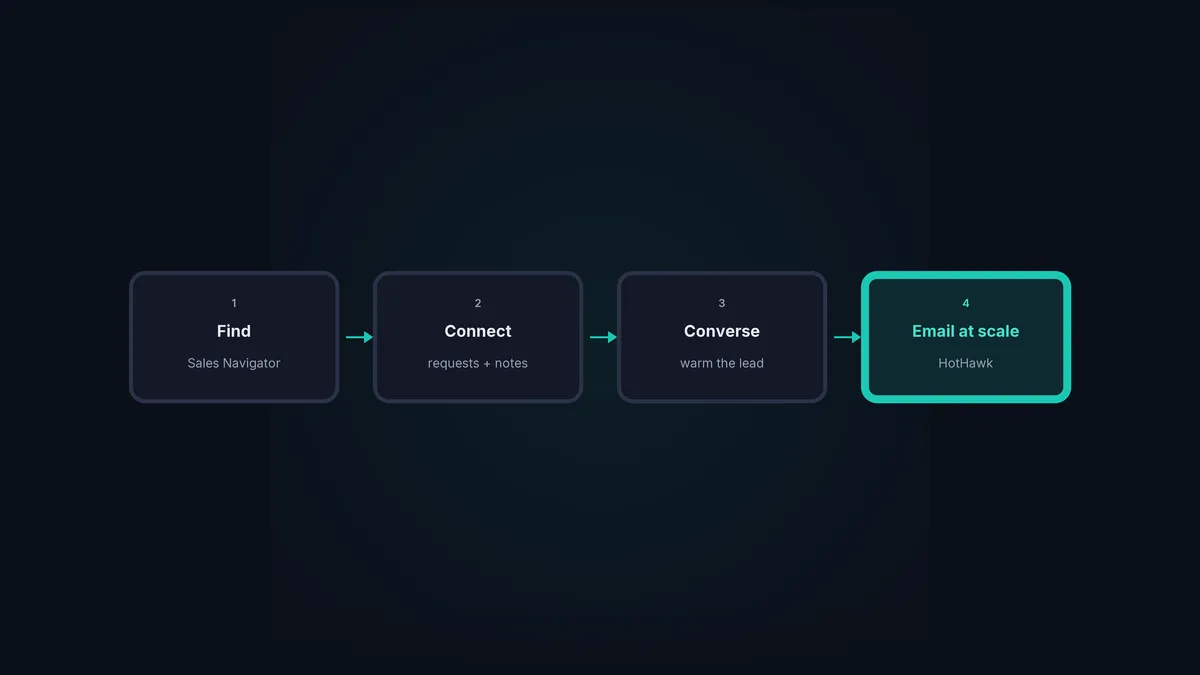
Lead generation on LinkedIn comes down to three moves: find the right people, get on their radar, and start a conversation worth having. Everything else is decoration.
The reason it works is trust. On LinkedIn you’re a real person with a face, a history and mutual connections, not an anonymous email address. That context makes people far more willing to reply. But it cuts both ways: because it’s personal, a lazy copy-paste pitch stands out as lazy, and the platform’s limits mean you can’t hide behind volume.
Find the right people first
Bad targeting is the number one reason LinkedIn outreach fails, and it’s the easiest thing to fix. Before you send anything, get specific about who you’re actually trying to reach, your ideal customer profile, down to the role, company size and industry.
Sales Navigator is the tool for this. It lets you filter LinkedIn’s whole membership by job title, seniority, company, headcount, geography and buying signals like a recent job change or funding round. That last part matters: reaching someone in their first month in a new role, when they’re actively looking to fix things, beats reaching the same person cold a year later.
Build a tight list of people who genuinely fit, not a broad one you’ll burn through. A hundred well-chosen prospects will out-perform a thousand vaguely relevant ones every time.
Warm them up, don’t pitch them
Here’s where most people blow it. They send a connection request with a pitch bolted onto it, or worse, connect and then immediately drop a sales message the moment it’s accepted. It reads as exactly what it is, and it kills the conversation before it starts.
The move that works is patience. Connect with a short, human note that says why you’re reaching out, no pitch. Engage with their posts. When you do message, lead with something relevant to them, a comment on their work, a genuine question, an observation, before you get anywhere near what you sell. You’re trying to earn a reply, not close a deal in message one.
Respect the limits
LinkedIn caps how much you can do in a day, deliberately, to keep the platform from turning into a spam channel. Safe daily activity sits at roughly 100 to 200 actions per account, connection requests, messages and the like, and pushing past that risks restrictions or a ban.
That cap is the whole reason LinkedIn is a high-trust, low-volume channel. It’s brilliant for reaching a specific, valuable set of people with a personal touch. It is not the channel for reaching thousands. If your target market is large, LinkedIn alone will never cover it, and that’s not a flaw to fight, it’s a signal to add a second channel.
Where email comes in
The teams that get the most out of LinkedIn don’t rely on it alone. They use it for what it’s good at, warm, targeted, personal outreach to high-value prospects, and they use email for what LinkedIn can’t do: volume.
A common play is to run LinkedIn and email together. Connect and warm a prospect on LinkedIn, then move the real conversation to email, where you’re not fighting a daily action limit and can follow up properly. Or work the two channels in parallel, LinkedIn touches for the top-priority accounts, email at scale across the wider list. The combination of inbound and outbound, and of channels within outbound, is what turns a trickle of LinkedIn chats into a predictable pipeline.
The catch is that email at scale needs its own machinery. Sending cold email to a real list means warmed mailboxes, sending across several of them so no one inbox gets burned, and somewhere to manage the replies when they come back. That’s a different job from LinkedIn outreach, and it’s the half that turns targeted interest into volume.
Run the email side of LinkedIn lead gen
HotHawk sends cold email at volume across warmed, rotated mailboxes and catches every reply in one Master Inbox, so the leads you warm on LinkedIn become pipeline you can scale.
Start your 7 day free trialA few common questions
Is LinkedIn good for lead generation? Yes, for the right job. It’s excellent for reaching a specific, valuable set of B2B buyers with a personal, high-trust touch. It’s poor for reaching a large market, because daily action limits cap your volume. Used alongside email, it’s one of the strongest B2B channels there is.
How many connection requests can I send on LinkedIn per day? Keep total daily activity to roughly 100 to 200 actions per account to stay safe, and connection requests should be a fraction of that. LinkedIn watches for spammy patterns, and pushing the limits risks restrictions, so steady and targeted beats high-volume.
Should I pitch in the connection request? No. A connection request with a pitch attached is the classic mistake. Connect with a short, human note and no pitch, then earn the conversation before you sell. The first goal is a reply, not a meeting.
Is LinkedIn or email better for lead generation? Neither, really, they do different jobs. LinkedIn is high-trust and low-volume; email is scalable but starts colder. The best B2B outbound uses both: LinkedIn for targeted, personal touches and email for reach.
LinkedIn rewards the opposite of what most people do on it: fewer, better-targeted prospects, warmed up patiently rather than pitched at. Get that right, pair it with email for the volume LinkedIn can’t provide, and you’ve got a lead generation engine rather than a stream of ignored requests. For more on building the wider system, the B2B lead generation strategies guide covers where LinkedIn fits alongside the rest.
