Pre-Warmed Mailboxes: What You're Actually Buying
What is HotHawk?
HotHawk is cold email software used by teams like yours to send high volume cold email.
Special offer
Get 50% more sending, FREE.
50% extra sending on any plan, every month.
On this page
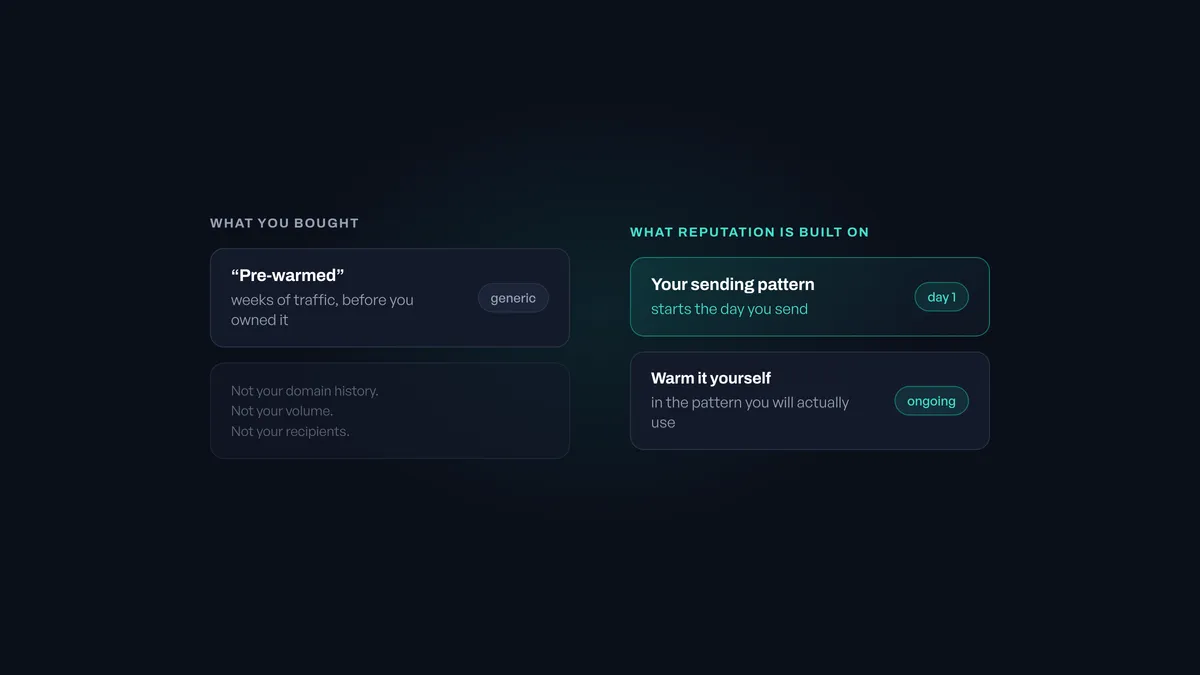
Several mailbox providers now sell “pre-warmed” accounts: mailboxes that have been sending and receiving for a few weeks before you buy them, so you can skip the wait and start sending properly on day one.
It is an appealing pitch, because warming is the boring part. It is also the part of a cold email setup that people most want to skip, which is exactly why it gets sold.
The honest answer is that pre-warmed mailboxes are worth something, and they are worth considerably less than the pitch implies. Here’s what you are actually buying.
The short version
- Pre-warming is real activity, but it is somebody else's activity.
- Reputation attaches to the domain and the mailbox, not to a warmth score.
- No provider can guarantee inbox placement, pre-warmed or otherwise.
- Your sending pattern is the thing providers learn, and it starts when you send.
- Treat a pre-warmed mailbox as not-from-zero, then warm it in your own pattern.
What “pre-warmed” actually means
In practice it means the provider has been running warmup traffic through the mailbox before handing it over. The account has sent some mail, received some mail, had some of it opened and replied to, and so it is not a brand new address with no history at all.
That is genuinely different from a mailbox created this morning. A completely fresh account on a completely fresh domain is the single most suspicious thing you can send cold email from, and starting slightly above that line is a real advantage.
What it is not is a finished job, and the reason is in what reputation is made of.
The bit the pitch skips
Mailbox providers are not maintaining a “warmth” number they hand you when you buy an account. They are building a picture of how this domain and this mailbox behave, and then watching whether that behaviour stays consistent.
Pre-warming builds that picture out of the provider’s traffic. Not yours. Specifically, it knows nothing about:
- Your domain’s history. If the mailbox comes on a domain the provider owns and rotates, you are inheriting whatever that domain has done before, which you cannot see.
- Your volume. Warmup traffic is a trickle. Your campaign is not. The jump from one to the other is the pattern change providers actually react to.
- Your recipients. Reputation is partly about who you send to and how they respond. Warmup replies come from the warmup network, not from your market.
- Your content. What you send, how it is written, how many links it carries, how people engage with it.
So the mailbox arrives with some history, and the moment you start a real campaign, you begin writing the history that counts. That starts on day one whatever you paid.
How email warmup works covers the mechanism in full, and why the pool composition matters explains why the inboxes doing the warming decide how much the signal is worth.
What it can’t guarantee, and nobody can
Be wary of any provider implying that a pre-warmed mailbox will reach the inbox. Nobody controls that, and anybody claiming otherwise is selling something.
Placement is decided per message, by the receiving provider, on signals that include your domain, your sending pattern, your content and how recipients respond. A mailbox’s prior activity is one input among many, and it is an input you did not generate. The honest framing is that pre-warming removes one disadvantage. It does not buy an outcome.
The same applies to our own warmup, and we would rather say so plainly: warmup is a practice that improves your odds, not a guarantee about any individual email.
The risks worth knowing about
A few things to check before buying, because “pre-warmed” is not a regulated term and it covers a wide range of practice.
- What was it warmed against? If the warming traffic came from bots or SMTP relays rather than real business inboxes, the activity is worth less than it looks. Ask what the network is made of.
- Whose domain is it? Some providers sell mailboxes on domains they own. Convenient, and it means the domain’s reputation history is not yours and not visible to you. Buying your own domains costs very little and you know where they have been.
- How old is the warmth? A mailbox warmed, then parked for two months before you bought it, has gone quiet. Quiet is closer to cold than to warm.
- Does it match what you will send? Warmup at twenty a day does not prepare a mailbox for a campaign at two hundred. The jump is still a jump.
How to tell whether a mailbox is actually warm
You cannot inspect a provider’s warmup history, but you can check the things that would show a problem, and it is worth doing on a sample before you connect fifty mailboxes to a campaign.
- Check the authentication. SPF, DKIM and DMARC should already be set and passing. If the provider has not done that, the “warming” was happening on a mailbox providers had reason to distrust anyway. Our SPF, DKIM and DMARC guide covers what correct looks like.
- Check the domain’s age and history. A domain registered three weeks ago has a three-week-old domain’s reputation however warm the mailbox feels. If you cannot find out when it was registered, that is itself an answer.
- Check it against a blacklist. Takes a minute, and a listed domain is a refund conversation rather than a warmup question. How to check an email domain blacklist covers where to look.
- Send yourself some mail. From the mailbox, to accounts on Gmail and Outlook you control, written like your actual campaign rather than a test. Which folder it arrives in tells you more than any warmth score.
None of this proves a mailbox is warm. It does catch the ones that clearly are not, which is the useful half.
So are they worth buying?
Sometimes, as a convenience rather than a shortcut.
They make sense if you are spinning up a lot of mailboxes at once and want them all slightly further along than zero, or if you are buying mailboxes from a provider you already trust and pre-warming is included rather than upsold. The time saved is real.
They do not make sense as a reason to skip your own warmup, or to start a real campaign at full volume on day one, or to pay a large premium on top of the mailbox price. The thing you are trying to buy, a mailbox that providers already trust to send your mail, is not for sale.
Several of the providers on the best cold email inbox providers offer pre-warmed options, and that page states what kind of mailbox each one actually sells, which matters more than whether it arrives warm.
What to do instead, or as well
Buy the mailboxes, pre-warmed or not, then:
- Warm them in the pattern you will actually use. Warmup running continuously alongside your real sending is what keeps the picture consistent, rather than a burst before you start.
- Ramp anyway. Start low, climb over two to four weeks. A pre-warmed mailbox can perhaps climb a little faster. It cannot skip the climb.
- Spread across domains. Reputation attaches to the domain too, so a pile of mailboxes on one domain share one fate.
- Keep warming. Reputation is not a state you reach and keep. It decays when sending patterns change, which they do every time you launch something new.
The warmup calculator will work out how much warmup volume your sending needs, which is the number that actually decides whether your mailboxes keep up.
The short version
A pre-warmed mailbox is a mailbox with somebody else’s history attached. That history is worth a little, it costs you a little, and it buys you a slightly better starting position than a cold account.
Your reputation starts when you start sending. There is no way to buy that in advance, from anyone, at any price. Warm your mailboxes in your own pattern, ramp like the domain is new, because as far as the receiving providers are concerned it mostly is.
